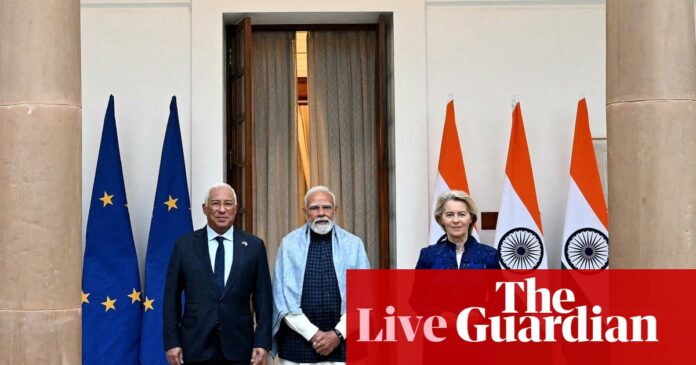

Morning opening: ‘The mother of all trade deals’
Jakub Krupa
The European Union has concluded trade talks with India this morning, signing also a bunch of separate deals on mobility, security, and defence, among others.
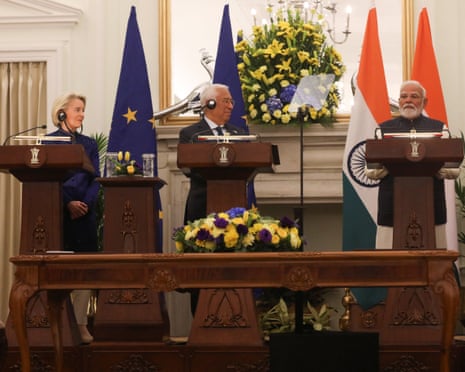
The accord would open up India’s vast and highly guarded market, with New Delhi slashing tariffs on cars to 10% over five years from as high as 110%, Reuters reported. The deal will also cut tariffs on a slew of EU goods coming to India including machinery, electrical equipment, chemicals and iron and steel, the EU said.
The EU is keen to stress that the EU and India already trade over €180bn worth of goods and services per year, supporting close to 800,000 EU jobs, and the EU’s goods exports to India is expected to double by 2032.
“This is the most ambitious trade opening that India has ever granted to a trade partner,” the bloc said, creating a market of more than 2 billion people.
India’s Narendra Modi welcomed the deal saying “the two largest democratic powers of the world are adding a decisive chapter to their relations,” as he hailed “the largest ever free trade agreement in its history.” The European Commission president, Ursula von der Leyen, went further and called it “the mother of all trade deals.”
The agreements will still need to go through the usual ratification process, including by the member states and the European parliament.
But there is no hiding away from the fact that the deal – 19 years in the making – gets also signed now as the EU urgently looks for new trade partners to diversify its trade given increasingly shaky relations with the US under tariff-happy Donald Trump. Earlier this month, the EU signed a deal with the South American bloc Mercosur, after 25 years of negotiations.
The European Council’s president António Costa – who holds an overseas citizenship of India thanks to his Goan roots – said that the deal “sends a clear message to the world at a time when the global order is being fundamentally reshaped.”
I will bring you the main reactions to the deal.
Separately, I will be keeping an eye on the latest on Ukraine and Greenland
It’s Tuesday, 26 January 2026, it’s Jakub Krupa here, and this is Europe Live.
Good morning.
Key events
EU-India deal ‘accelerated with gusto’ over past six months amid Trump’s tariff threats – snap analysis

Hannah Ellis-Petersen
South Asia correspondent
in New Delhi
India, the world’s largest country with a population of 1.4 billion, is also one of the world’s fastest-growing economies and is on track to become its fourth-largest economy this year, according to the International Monetary Fund.
The deal is one of the most comprehensive that India has ever signed and Narendra Modi emphasised that it represented about a third of global trade, calling it the “biggest free trade deal in history”.
“This agreement has brought massive opportunities for 1.4 billion Indians and millions of people in European countries,” he said. “It has become a wonderful example of synergy between two of the world’s major economies.”
Trade talks between the two countries began as far back as 2007 but were abandoned owing to disputes over access to cars, agriculture and dairy.
However, they were resumed again in 2022 and accelerated with gusto over the past six months in the face of heavy punitive tariffs by Donald Trump’s administration in the US and joint concerns over China’s monopoly over global manufacturing and the country’s restrictions on key exports.
According to officials, the formal signing of the deal will take place later this year and it could come into play by early next year.
It’s quite notable how relations with India picked up over the last year as Europe looks to find new markets as a result of Trump’s erratic trade policy.
German chancellor Friedrich Merz was in India earlier this month, talking about the relationship being a “high priority” for his government.
France’s Emmanuel Macron is expected to follow next month, attending the AI Impact Summit, and he pointedly shared a selfie with India’s prime minister Narendra Modi last night, marking India’s Republic Day celebrations.
Italy’s Giorgia Meloni spoke with Modi late last year, offering her backing for the EU-India trade deal, too, and her foreign minister, Antonio Tajani, visited the country in December with a 50-strong delegation with representatives of Italian businesses.
Chair of the European Parliament’s international trade committee, Bernd Lange, said “the conclusion of negotiations with India offers a glimmer of hope amid a chaotic geopolitical situation.”
“The EU is not alone in its insistence on a rules-based order. This is only the beginning of close cooperation with India. We can build on this foundation in the future,” he said.
Germany has rushed to welcome the deal, saying it could support growth at a time of increasingly challenging ties with other major economies, AFP reported.
“This agreement creates new opportunities for growth and good jobs – in Europe and India alike – while deepening the strategic partnership with the world’s largest democracy,” said Lars Klingbeil, Germany’s finance minister.
If you are after a detailed “fact sheet” on the deal, the EU’s document is here.
It says the agreement will save up to €4bn per year in duties on European products and pointedly says it is the biggest trade opening India has given to any trade partner (hello UK).
Here are some specific examples from the Q&A:
“For example, tariffs on cars will gradually go down from 110% to 10% with a quota of 250,000 vehicles a year. High tariffs of up to 44% on machinery, 22% on chemicals and 11% on pharmaceuticals will be mostly eliminated.”
Morning opening: ‘The mother of all trade deals’

Jakub Krupa
The European Union has concluded trade talks with India this morning, signing also a bunch of separate deals on mobility, security, and defence, among others.
The accord would open up India’s vast and highly guarded market, with New Delhi slashing tariffs on cars to 10% over five years from as high as 110%, Reuters reported. The deal will also cut tariffs on a slew of EU goods coming to India including machinery, electrical equipment, chemicals and iron and steel, the EU said.
The EU is keen to stress that the EU and India already trade over €180bn worth of goods and services per year, supporting close to 800,000 EU jobs, and the EU’s goods exports to India is expected to double by 2032.
“This is the most ambitious trade opening that India has ever granted to a trade partner,” the bloc said, creating a market of more than 2 billion people.
India’s Narendra Modi welcomed the deal saying “the two largest democratic powers of the world are adding a decisive chapter to their relations,” as he hailed “the largest ever free trade agreement in its history.” The European Commission president, Ursula von der Leyen, went further and called it “the mother of all trade deals.”
The agreements will still need to go through the usual ratification process, including by the member states and the European parliament.
But there is no hiding away from the fact that the deal – 19 years in the making – gets also signed now as the EU urgently looks for new trade partners to diversify its trade given increasingly shaky relations with the US under tariff-happy Donald Trump. Earlier this month, the EU signed a deal with the South American bloc Mercosur, after 25 years of negotiations.
The European Council’s president António Costa – who holds an overseas citizenship of India thanks to his Goan roots – said that the deal “sends a clear message to the world at a time when the global order is being fundamentally reshaped.”
I will bring you the main reactions to the deal.
Separately, I will be keeping an eye on the latest on Ukraine and Greenland
It’s Tuesday, 26 January 2026, it’s Jakub Krupa here, and this is Europe Live.
Good morning.