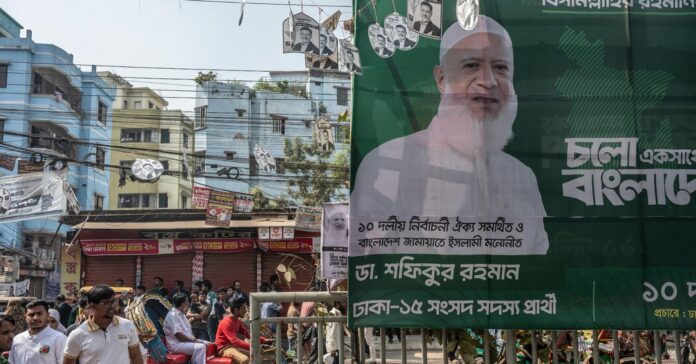

The youth wing of an Islamist political party in Bangladesh stunned the country in September when it secured a landslide victory in the student elections at the University of Dhaka, a bastion of left-liberal politics where the 2024 revolution was hatched.
It was the first sign that a new power broker had entered mainstream politics in Bangladesh, which had been governed mainly by two dynastic political parties since attaining nationhood in 1971.
The party, Jamaat-e-Islami, proved on Thursday that its early successes were not a fluke. In the first national elections to be held since the 2024 revolution — when students toppled the government of Sheikh Hasina, an autocratic dynast — the party won nearly a quarter of seats. While the Bangladesh Nationalist Party led by Tarique Rahman, the scion of the country’s other political dynasty who is set to become prime minister, won a clear majority, Jamaat did far better than it ever had previously by winning 68 of the 297 seats.
Two months earlier, Jamaat had dealt another surprise when it formed an alliance with the National Citizen Party, formed in 2025 by the leaders of the student uprising. The N.C.P. sought to build a more inclusive democracy respectful of political freedoms and women’s rights, at odds with one of Jamaat’s core tenets: that women should participate in public life only according to Islamic principles.
The rise of a new political force shows the tectonic shifts in the political landscape of Bangladesh wreaked by the student movement, but not quite as the students had envisaged. The N.C.P. said it had formed an electoral alliance with Jamaat because it would increase its chances of winning seats, given Jamaat’s wide student network.
The N.C.P. won just six of the 30 seats it contested.
There was a separate triumph for the students who led the 2024 revolution: In a referendum also held on Thursday, voters overwhelmingly backed constitutional reforms intended to safeguard democracy and prevent a return to autocracy, including introducing a bicameral legislature and setting term limits for prime ministers.
However, the student movement that brought down an entire government might find it hard to sustain its energy, mirroring other student movements like those involved in the 2011 Arab Spring, which shook up governments in many countries but did not leave a lasting legacy, analysts said.
“It will fizzle out,” said Mujibur Rehman, a political scientist at Jamia Millia Islamia University in Delhi. Such groups have “no political experience, so they obviously can’t sustain themselves beyond a point.” Student leaders typically do not fit into the system of patronage politics that demands loyalty and is common in South Asia, said Dr. Rehman, who studies identity politics in the region. “The politics and rhetoric and strategies that work on university campuses don’t work in the real world” unless student leaders change themselves, he said.
Tying up with Jamaat, whose youth wing, Bangladesh Islami Chhatrashibir, won university elections in four of Bangladesh’s biggest schools between September and October, was an attempt by leaders of the student movement to keep a foothold in politics, Dr. Rehman said.
The marriage of convenience has provided Jamaat the political visibility it had sought for decades, while also presenting itself as a moderate party. Founded in 1941 and inspired by the Muslim Brotherhood, Jamaat was sidelined in Bangladeshi politics after supporting Pakistan during Bangladesh’s bloody struggle to break away from it.
Although it found a niche under former B.N.P. governments — even winning 18 seats in the 1991 general election and holding two cabinet posts — it was largely an underground movement, suppressed during the 15-year rule of Ms. Hasina.
But Jamaat did not stop its work, wooing supporters disaffected with dynastic politics, including younger generations. Mosques and madrassas were central locations for Jamaat’s work. History was on its side.
The “post-9/11 syndrome,” which led to a demonization of Muslims globally, and the rise of the right-wing Hindu movement in India, known as Hindutva, brought more people into Jamaat’s fold, said Iftekharuzzaman, the executive director of Transparency International Bangladesh, who had a hand in shaping Bangladesh’s reform agenda after the 2024 revolution.
“Hindutva’s implication in Bangladesh and 9/11’s implication in Bangladesh is the same result,” said Dr. Iftekharuzzaman, who goes by one name. Jamaat’s strongest victories were in divisions bordering India, such as Khulna and Rajshahi. Widespread corruption and the lack of job opportunities only added to people’s grievances. “It was a vote of people looking for alternatives,” he said. Jamaat also benefited on Thursday from the absence of the Awami League, which used to be Bangladesh’s largest party before it was banned from participating in the election, he said.
Meghmallar Bosu, a student political activist from the Hindu minority in Bangladesh, said he had felt a sense of insecurity and “political marginalization” in the year and a half since the revolution. Speaking two days before the election, Mr. Bosu said he would rather vote for a candidate who was likely to defeat the Islamist candidate. More than 50 parties stood for election; many of them, like Islami Andolan Bangladesh, are far-right Islamist parties.
When the student demonstrations started in July 2024, they were initially to protest against a system of reserving jobs, including for the descendants of Bangladeshi freedom fighters. But after troops started a crackdown on Ms. Hasina’s orders, the protests became an all-encompassing movement against authoritarian rule that ultimately forced her to quit as prime minister and flee to India.
Hundreds of students backed by both the B.N.P. and Jamaat joined the protests, as each party saw an opening to overthrow the Awami League and pursue its own goals. But once the furor died down, the task of creating proposals to rebuild the country as envisioned by student leaders became bogged down by political bickering and extended negotiations.
The B.N.P., Jamaat and smaller parties opposed many of the original suggestions provided by 11 reform commissions set up by Muhammad Yunus, the Nobel Peace Prize laureate, who acted as chief adviser to the interim government.
In April, the Women’s Affairs Reform Commission released a slate of proposals, such as creating equal inheritance rights for women, increasing their political representation and recognizing sex work as a profession.
Shafiqur Rahman, the leader of Jamaat, said at the time that the commission and its recommendations should be rejected. Earlier this month, Mr. Rahman compared women working to prostitution in a post on social media, which was later taken down after his office said his account had been hacked.
By teaming up with Jamaat, the N.C.P. infuriated many of the female protesters and leaders, who saw it as a betrayal of their cause.
“The youth had upheld their faith that N.C.P. would be the political party that was pro-people,” said Taposhi Rabeya, a student activist. But after aligning with Jamaat, “they could not uphold their ideology,” Ms. Rabeya said.
Leaders of the student party insisted that it was a strategic rather than ideological alliance. Since building a grass roots network was impossible for an organization founded less than a year ago, an alliance was necessary, N.C.P. members said.
“And then we looked at who is more pro reform,” said Saleh Uddin Sifat, a senior leader of the party. Although he said they still had reservations, “We saw Jamaat is more pro-reform here, and then we joined them.”