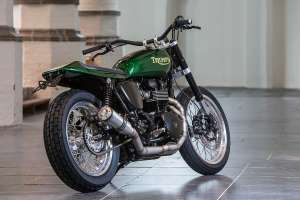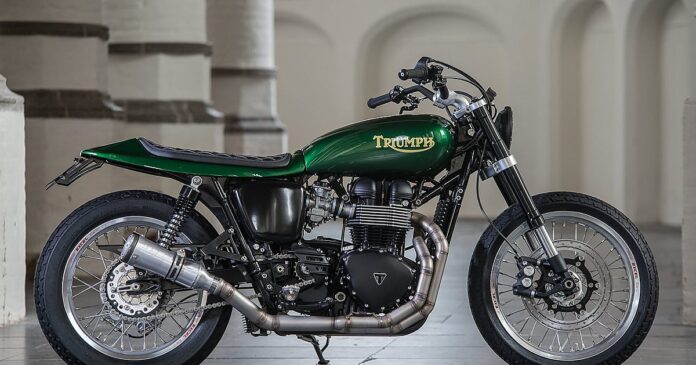

Known for its wild customs, Rno Cycles tones it down with a Triumph Bonneville T100 street tracker that cuts a timeless silhouette.
As the man behind Rno Cycles, Arno Overweel specializes in custom bikes that range from wild to outright nuts. One minute, he’s slapping a turbo-charger on a Honda CBX 1000, the next, he’s shoving a Suzuki GSX-R750 engine in a GS1000 frame with wide wheels. But when a client asked for something a little milder, he was still happy to oblige.
It helped that the client was a repeat customer. The CBX belongs to him, as does another Rno creation—an outrageous Harley Shovelhead. This time around, he asked the Dutch custom builder to create an understated Triumph Bonneville street tracker with factory-level finishes.
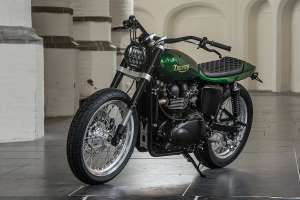
“After the American and Japanese bikes, the question arose, ‘What’s next?’,” says Arno. “That’s how the client came up with the idea of using an English motorcycle.”
“I asked if he wanted an old English motorcycle or something modern. After some brainstorming, we went with a newer Triumph Bonneville. With a classic bike, an engine rebuild already takes up a lot of the budget—besides, a modern Triumph always rides and handles well.”
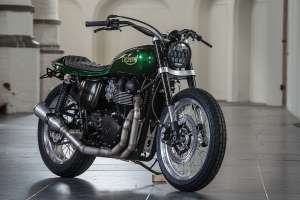
While scouring the interweb for inspiration, Arno discovered a Bonneville street tracker from the king of flat track builds—Richard ‘Mule’ Pollock. He sent some images to his client as a reference, thinking, “If he likes this, we’ll get somewhere!” The client was immediately on board, so Arno sourced a 2015-model Triumph Bonneville T100 and began planning the build.
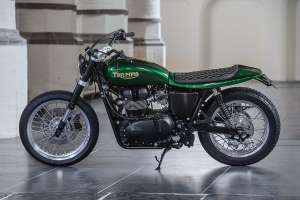
“My recent projects have a practical, rideable style,” he adds, “with few compromises on comfort. That’s not a path I consciously took, by the way—I’d love to build another pointless show bike.”
“It was absolutely clear that the Bonneville needed an upside-down fork, just as it needed a different, more streamlined fuel tank. And, in keeping with Rno’s style, it needed numerous modern components. The owner also had a few requests—he wanted a pillion seat and the color British Racing Green.”
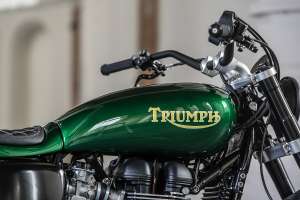
It didn’t take long for Arno to figure out why the Triumph’s OEM fuel tank was so bulbous. “There’s a fuel pump unit in there, with a filter,” he explains. “Of course, the pump is necessary for fuel injection, so I couldn’t ignore that.”
Arno got his hands on a pre-owned Yamaha XS650 tank, plus a damaged Bonneville unit. He then cut up the Bonneville tank for its floor, tweaked the fuel pump mount so that it would take up less space, and welded the shell of the XS650 tank onto it. It took a lot of trial and error—but the end result is seamless.
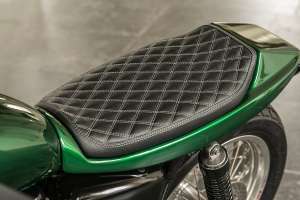
The tail section called for similar fettling. Starting with an aftermarket flat track tail piece, Arno split it along its length and widened it using fiberglass and epoxy resin. He used a similar trick to graft on the front bit from the Bonneville’s stock seat pan, ensuring a tight fit with the fuel tank.
Silver Machine added the diamond-stitched upholstery, while Arno trimmed the subframe for a neater fit. “The seat is slightly narrower than the original, but wide enough for a comfortable ride,” he says. “Despite being a two-up seat, it has a subtle and proportionate look.”
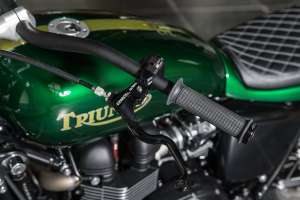
Moving to the chassis, Arno used CAD software to design a set of yokes that could hold the upside-down forks from a Kawasaki Z1000. The pulled-back handlebar risers are one-offs, too, while wide flat track bars are from ProTaper. They’re fitted with Daytona grips, and Beringer controls with integrated switchgear from Renard Speed Shop in Estonia.
The speedo’s a Motogadget part, and there’s an LED headlight fitted out front. Other upgrades include Kellermann turn signals and taillights, and SW-Motech footpegs. Arno modified the foot controls before fitting the new pegs, and swapped the clunky pillion footrests for something slicker.
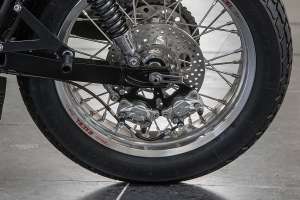
The Bonneville’s 19F/17R wheelset didn’t quite fit the bill on this project, so Arno turned to Haan Wheels for a replacement. Billet hubs were matched to 19F/18R Excel rims, with stainless steel spokes and fresh bearings. Dunlop DT3-R tires were chosen for their combination of flat track aesthetics and street-specific grip.
Arno Frankensteined the brakes as well, matching a Honda NTV650 disc to a Yamaha MT01 caliper at the front. The rear brake uses not one, but two Brembo calipers, with CNC-machined mounting adapters in play at both ends.
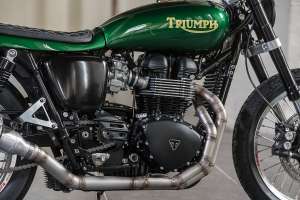
The last big-ticket item on Arno’s list was the exhaust. At the customer’s request, he welded together a two-into-one stainless steel system with a kick in the rear, capping it off with a Supertrapp muffler. Then he handed the bike over to painter Ben Oud, who hit it with a deep green candy livery, featuring gold and silver highlights.
Arno also spent a lot of time taking care of minor details that might otherwise go unnoticed. Most of the wiring is hidden under the fuel tank, the frame’s been cleaned up in key places, and unsightly bits like the horn and regulator have been hidden away. A handful of parts from Motone finish off the build, including an ignition relocation bracket, oil filler cap, and front sprocket cover.
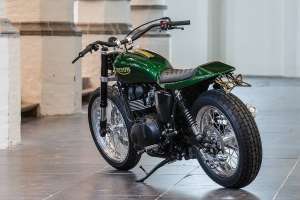
“There’s a lot of work in this project that people probably won’t see because it looks so simple—as if it came straight from the factory like that,” Arno adds. “That’s precisely where all the energy goes! If you’ve never built something like this yourself, you won’t understand that.”
Rno Cycles | Facebook | Instagram | Images by Floris Velthuis